
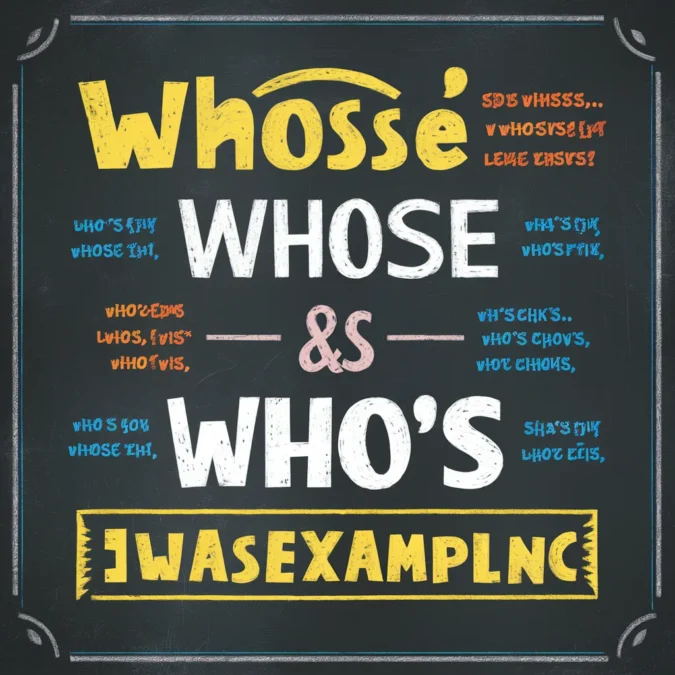

English grammar can sometimes be confusing, especially when words sound exactly alike but have completely different meanings and uses. One of the most common grammar mistakes people make involves the words “whose” and “whose vs who’s.” Because both words are pronounced the same way, many writers accidentally use the wrong spelling in emails, essays, social media posts, and professional documents. Understanding the difference between these two words is essential for improving grammar, writing accuracy, and communication skills.
The confusion between whose and who’s usually happens because one word shows possession while the other is a contraction. Even native English speakers occasionally mix them up. However, once you learn the basic grammar rule and practice with examples, distinguishing between the two becomes much easier. Knowing when to use whose and who’s correctly can make your writing appear more polished, professional, and grammatically correct.
In this complete guide, you will learn the meaning of whose and who’s, their grammatical differences, common mistakes people make, simple memory tricks, and plenty of examples to help you master their usage confidently.
What Does “Whose” Mean?
The word “whose” is a possessive pronoun. It is used to ask or describe ownership, possession, or relationships. In simple terms, whose refers to something belonging to someone.
For example:
- Whose book is this?
- Do you know whose phone is ringing?
- She met the teacher whose class won the competition.
In each example, whose asks about or describes ownership. The word helps identify who something belongs to. Because it is possessive, it functions similarly to words like “his,” “her,” or “their.”
Whose can also connect clauses in a sentence. In grammar, this usage is known as a relative pronoun. For example:
- The student whose project won the award was very happy.
Here, whose explains which student is being discussed by showing ownership of the project.
What Does “Who’s” Mean?
The word “who’s” is a contraction. It combines the words “who” and “is” or “who” and “has.”
For example:
- Who’s coming to the party?
- Who’s finished the assignment?
- Do you know who’s at the door?
If you expand the contraction, the sentence still makes sense:
- Who is coming to the party?
- Who has finished the assignment?
This is the easiest way to determine whether who’s is correct. If you can replace the word with “who is” or “who has,” then using who’s is appropriate.
The Main Difference Between Whose and Who’s
The simplest way to understand the difference is this:
- Whose = possession or ownership
- Who’s = who is or who has
This distinction is very important because using the wrong form changes the grammar and can confuse readers. Consider these examples:
- Correct: Whose jacket is on the chair?
- Incorrect: Who’s jacket is on the chair?
The second sentence is wrong because “who is jacket” does not make grammatical sense.
Another example:
- Correct: Who’s ready for dinner?
- Incorrect: Whose ready for dinner?
In this case, “whose” cannot replace “who is,” so the sentence becomes incorrect.
Easy Trick to Remember the Difference
One of the best grammar tricks for remembering the difference is to focus on the apostrophe.
The apostrophe in who’s signals that letters are missing because it is a contraction. Whenever you see an apostrophe, try expanding the word into “who is” or “who has.”
For example:
- Who’s calling me?
Becomes: Who is calling me?
If the expanded version works, then who’s is correct.
On the other hand, whose has no apostrophe because it is possessive. Similar possessive pronouns like his, hers, theirs, and yours also do not use apostrophes.
This simple memory technique can help you avoid one of the most common grammar mistakes in English writing.
Common Mistakes People Make
Many people accidentally use who’s when they should use whose because they assume the apostrophe automatically indicates possession. In English grammar, however, apostrophes usually show contractions or possession for nouns, but possessive pronouns generally do not include apostrophes.
Examples of incorrect usage include:
- Who’s bag is this?
- I know the person who’s car was stolen.
- Whose going to the meeting?
Corrected versions:
- Whose bag is this?
- I know the person whose car was stolen.
- Who’s going to the meeting?
These mistakes are extremely common in social media posts, online comments, text messages, and even academic writing. Careful proofreading can help identify and fix these errors.
Examples of Whose in Sentences
Understanding real examples can make grammar rules easier to remember. Here are several sentences using whose correctly:
- Whose shoes are near the door?
- The writer whose novel became famous won an award.
- Do you know whose backpack this is?
- She adopted a dog whose owner moved overseas.
- The artist whose painting sold for millions became internationally recognized.
In all these examples, whose relates to ownership or association.
Examples of Who’s in Sentences
Now consider examples using who’s correctly:
- Who’s interested in joining the team?
- Do you know who’s speaking tonight?
- Who’s completed the project report?
- I wonder who’s been calling repeatedly.
- Who’s going to explain the new rules?
Each sentence can be expanded into “who is” or “who has,” confirming correct usage.
Why Grammar Accuracy Matters
Using correct grammar improves communication and professionalism. Small mistakes like confusing whose and who’s may seem minor, but they can affect how readers perceive your writing. In professional settings such as emails, resumes, academic assignments, or business reports, grammatical accuracy demonstrates attention to detail and language skills.
Good grammar also helps avoid misunderstandings. Readers can quickly understand your message when sentences are written correctly and clearly. In digital communication, where written language dominates conversations, strong grammar skills are increasingly valuable.
Students preparing for exams, writers creating online content, and professionals communicating in the workplace all benefit from mastering commonly confused words like whose and who’s.
How to Practice Using Whose and Who’s
Improving grammar requires regular practice and reading. One effective method is writing your own example sentences and testing whether “who is” or “who has” fits naturally. Reading books, articles, and professionally edited content can also strengthen understanding of grammar patterns.
Online grammar quizzes and proofreading tools may help reinforce the difference between these commonly confused words. Additionally, slowing down while writing and reviewing sentences carefully can prevent simple mistakes.
The more often you use these words correctly, the more natural the distinction will become over time.
Conclusion
The difference between whose and whose vs who’s is one of the most important grammar rules for English learners and writers. Although the words sound identical, they serve completely different purposes in a sentence. Whose is used to show possession or ownership, while who’s is a contraction meaning “who is” or “who has.”
Understanding this grammar rule can significantly improve writing accuracy, professionalism, and confidence. By remembering the simple apostrophe trick and practicing with examples, anyone can avoid this common mistake. Whether you are writing school assignments, business emails, social media captions, or blog articles, using whose and who’s correctly will strengthen your communication skills and make your writing more polished.
Frequently Asked Questions (FAQ)
What is the difference between whose and who’s?
Whose shows possession or ownership, while who’s is a contraction of “who is” or “who has.”
Is whose possessive?
Yes. Whose is a possessive pronoun used to indicate ownership or relationships.
What does who’s mean?
Who’s means “who is” or “who has.”
How can I tell which word to use?
Try replacing who’s with “who is” or “who has.” If the sentence still makes sense, use who’s. If not, use whose.
Why is this grammar mistake so common?
The words sound identical when spoken, which causes confusion in writing.
Do possessive pronouns use apostrophes?
Usually no. Possessive pronouns like his, hers, yours, theirs, and whose do not use apostrophes.